
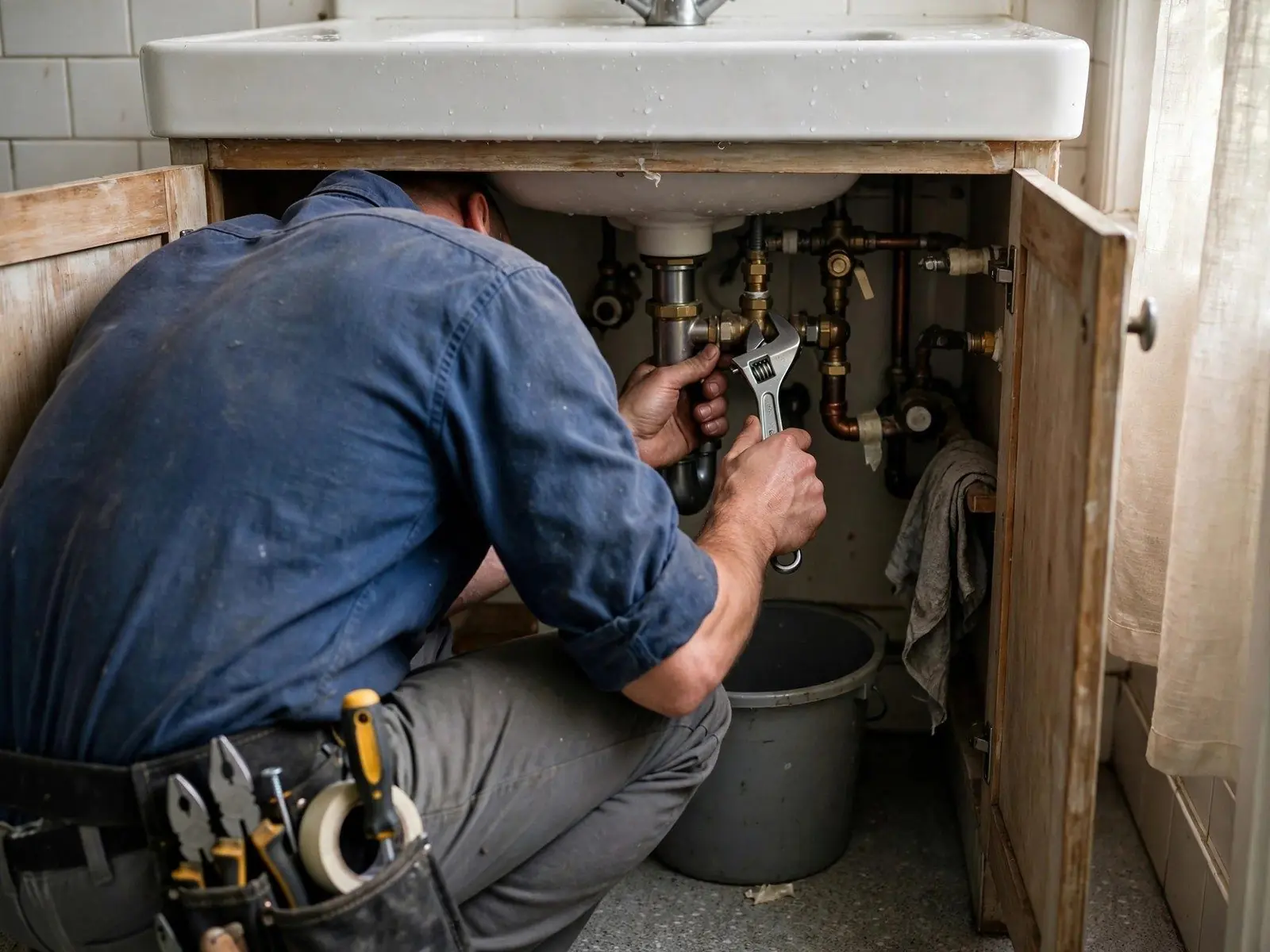
This guide describes how a sink is plumbed in a typical Cottage Grove home, what tools you need and where homeowners most often run into trouble.
The three parts of sink plumbing
| Part | Components | What it does |
|---|---|---|
| Supply | Shutoff valves, supply lines, faucet | Brings hot and cold water to the faucet |
| Faucet | Spout, handles, cartridge, mounting hardware | Mixes and controls the flow |
| Drain | Pop-up assembly, tailpiece, P-trap, trap arm | Carries wastewater into the wall drain |
Get these three right and the sink works for decades. Get one wrong and you will see a drip, a smell or a slow drain.
Tools and parts
- Adjustable wrench and basin wrench
- Channel-lock pliers
- Plumber's putty or silicone, depending on the faucet and sink
- Flexible supply lines
- A P-trap kit with slip nuts and washers
- A bucket, towels and a flashlight
Installing the faucet and drain
Set the faucet
Mount the faucet to the sink before the sink goes on the vanity. It is far easier to reach from above.
Install the pop-up drain
Seal the flange with putty, tighten the nut from below and connect the pivot rod to the stopper.
Place the sink and connect supply lines
Set the sink, then connect hot and cold lines from the faucet to the shutoff valves.
Connect the trap
Attach the P-trap to the tailpiece and the trap arm, and tighten slip nuts by hand plus a gentle turn with pliers.
Under the vanity and stuck?
Call and a licensed plumber can finish the job and check for leaks.
The P-trap and why it matters
The P-trap is the curved section that holds a small amount of water. That water blocks sewer gas from rising through the drain. A sink with no trap, or with a trap that has dried out, can smell, and one with a poorly aligned trap will leak or drain slowly.
The trap connects to a horizontal pipe called the trap arm, which runs into the wall. The trap arm should slope slightly toward the wall drain. A slope that is too flat holds water, and one that is too steep can leave solids behind. If the wall stub is at the wrong height, the trap will not line up, and a plumber can adjust it.
Venting: the invisible part
Behind the wall, every drain is connected to a vent. Without it, water leaving the trap can pull air through the water seal and cause gurgling and slow drains. If your new sink gurgles or your old sink starts to, the vent may be blocked or too far away.
A vent problem is often the cause when a sink drains slowly even though the pipes are clear. It is also why moving a sink to a new spot is more than a drain change, as covered under plumbing installation.
Test it before you finish
Leak test
- Turn on each shutoff valve slowly
- Run hot and cold water and check each fitting with a dry paper towel
- Fill the sink and release it to test the drain
- Look for drips after ten minutes
- Check again the next day
Most leaks show up on a dry paper towel before anyone sees a drip.
DIY is reasonable when
- You are replacing a sink or faucet in the same spot
- The shutoff valves work
- The drain lines up with the wall stub
Call a plumber when
- You are moving the sink
- Shutoff valves will not close
- The drain or vent needs work
- You see corroded or leaking pipes
Choosing supply lines and shutoff valves
Braided stainless supply lines are common and flexible, and they handle small differences in alignment. Pick lengths that reach without being stretched, and avoid tight kinks. Hot is on the left and cold on the right at most faucets.
Shutoff valves under the sink are worth replacing at the same time, especially older multi-turn valves that have not been used in years. Quarter-turn ball valves are easier to operate and less likely to leak when you need them. If a shutoff valve will not close, shut off the main water and replace it, since you will want a working valve the next time.
Common leak points
- The slip nut on the trap, which needs the washer facing the right way
- The pop-up drain flange, where too little putty leaves a weep
- The supply line nuts, which should be snug but not overtightened
- The faucet base, where a gasket may be missing or misaligned
- The overflow hole connection on a vanity sink
Most of these leaks show up as a damp paper towel before they drip. Fixing them is a matter of backing off, reseating the washer and tightening evenly.
Cottage Grove note: permits and licensed work
Follow the faucet and drain manufacturers' guidelines for each part. Replacing a sink in the same location is a repair for most homeowners, while new rough-in, relocated drains or a new vent typically fall under the Minnesota Plumbing Code and may involve permits and inspections.
Ask the City of Cottage Grove building department what your project needs. For work in Hastings or another nearby city, check with that city's office, since each city sets its own procedures.
Moving a vanity or adding a sink in a nearby town is common. See the service area for the towns we reach and the Hastings plumbing page for the south side.
Questions homeowners ask
A same-location replacement often takes a couple of hours. Moving a drain or a vent takes longer.
Follow the faucet and sink manufacturer. Putty is common on metal flanges. Silicone is better for some stone and porous surfaces.
Check the trap alignment, the stopper adjustment and the vent. A slow drain after a new install often points to a trap that is not sloped right.
Often not for a same-location swap, but moving drains or adding fixtures usually does. Ask your city.
A dry trap, a loose connection or a vent problem. Pour water into the sink to refill the trap, then check connections.
The City of Cottage Grove building department.