
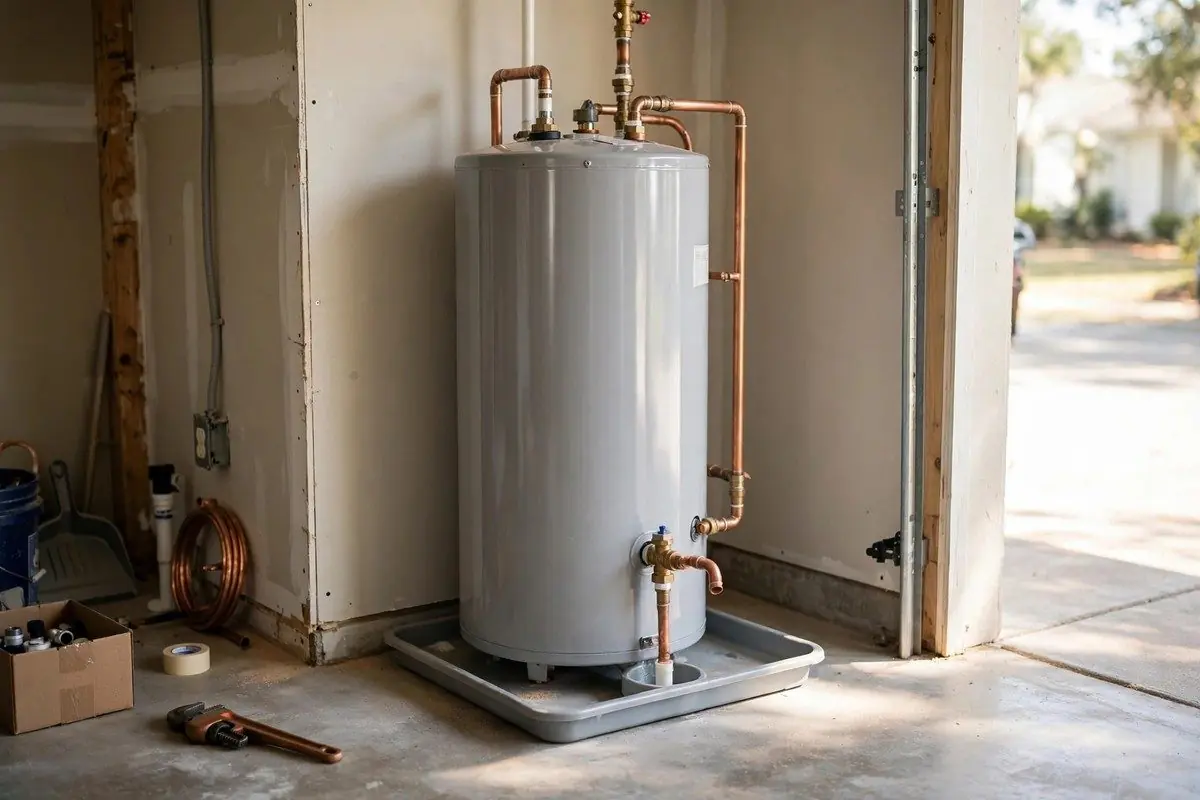
When a failed tank is an emergency
Water pooling around the base, a steady drip from the shell or a tank that rumbles and hisses all signal a failing heater. A burst tank can release dozens of gallons, which is enough to damage drywall, flooring and anything stored on the basement floor.
Call right away and we can often replace the unit on the same day. If it is after hours, the 24/7 line takes the call, and the plan and price are confirmed before work starts.
Choosing the replacement
| Option | Best fit | Trade-off |
|---|---|---|
| Standard tank, gas | Homes with a gas line and an existing vent | Lower upfront price, uses a flue |
| Standard tank, electric | Homes without gas service | Simple install, higher energy use |
| Heat pump (hybrid) | Households focused on efficiency | Needs space and air around the unit |
| Tankless | Households needing steady hot water | Higher cost, vent and gas line may need work |
If a tankless unit appeals to you, the tankless page covers sizing, venting and flushing. For most emergencies, a like-for-like tank swap is the fastest way to restore hot water, and you can plan an upgrade later.
Hot water gone for good?
Call the 24/7 line and ask about a same-day replacement.
What a replacement visit includes
Shut off and drain
The old tank is isolated, drained and disconnected from water, power or gas.
Remove and prepare
The old heater leaves, and the area is checked for rot, rust and drain access.
Set and connect
The new tank goes in a drain pan with new connectors, valves and a proper discharge pipe.
Test and review
We check for leaks, vent draft on gas units and settings, then walk you through shutoffs and maintenance.
Sizing for a Cottage Grove household
A tank that is too small runs out in a busy morning. One that is too large wastes energy keeping extra water hot. As a starting point, a household of two to three people often does well with a mid-size tank, and a family of five with several bathrooms may want a larger tank or a different type.
Cottage Grove has a lot of homes from the 1990s and 2000s with finished basements and multiple bathrooms. Those homes often have a water heater tucked in a utility room next to the furnace, where venting and clearances matter. We check them before ordering, so the new unit fits the space and the vent works.
Code and permits
Water heater work in Minnesota is governed by the Minnesota Plumbing Code, and licensed plumbers are credentialed through the Minnesota Department of Labor and Industry. A replacement usually requires a permit from the city, and the plumber handles that step.
Ask the building department in your city what it requires, and keep the permit record with your home papers. It matters at resale.
Replace now
- Stops the water damage risk
- Restores hot water the same day when available
- Lets you choose the right size
Wait and watch
- A leaking shell only gets worse
- Risk of a burst during a cold snap
- Higher cleanup cost if it fails at night
What to do before we arrive
- Shut off the cold water supply and the power or gas
- Move anything stored near the tank
- Clear a path from the door to the heater
- Put towels or a bucket around any leak
- Note the make, model and any vent issues
Getting the most from a new heater
A new tank should last for years with basic care. Flush it periodically, check the relief valve each year and ask about an expansion tank if your system has a pressure regulator or a backflow valve on the supply. Those details are cheap compared with replacing another tank early.
For a full look at planned work rather than an emergency, see water heater installation.
Disposal, warranty and paperwork
The old heater is hauled away, and the manufacturer's warranty information and the permit record, when one applies, stay with you. Keep both with your home papers.
Registering the new heater with the manufacturer is a short step that can matter later, so we remind you at the end of the visit.
Code, permits and standards
Replacing a tank is a code item. The Minnesota Plumbing Code applies, required inspections must be performed, and gas units also involve venting and combustion air standards in the manufacturer's instructions. We handle the permit steps your city requires and leave you the record.
Water Heater Replacement questions in Cottage Grove
Yes, we take replacement calls at all hours. A tank that is leaking from its body cannot be repaired, so close the water and the power or gas to it and call the 24/7 line. A plumber can be booked the same day when available.
Many standard tank swaps are completed in a few hours. Changes to venting, gas lines or location add time, and we explain the timeline before work starts.
If water appears at the base and the fittings on top are dry, the shell is the likely source. A plumber can confirm by drying the area and watching where the water returns.
Often yes. The plumber handles the permit steps with your city. Ask the local building department what it requires.
Yes, but it usually needs venting and gas line work. For an emergency, a tank swap is faster, and a tankless upgrade can follow later.
Replacements are scheduled in Cottage Grove and nearby communities such as Hastings. The service area page lists them.