
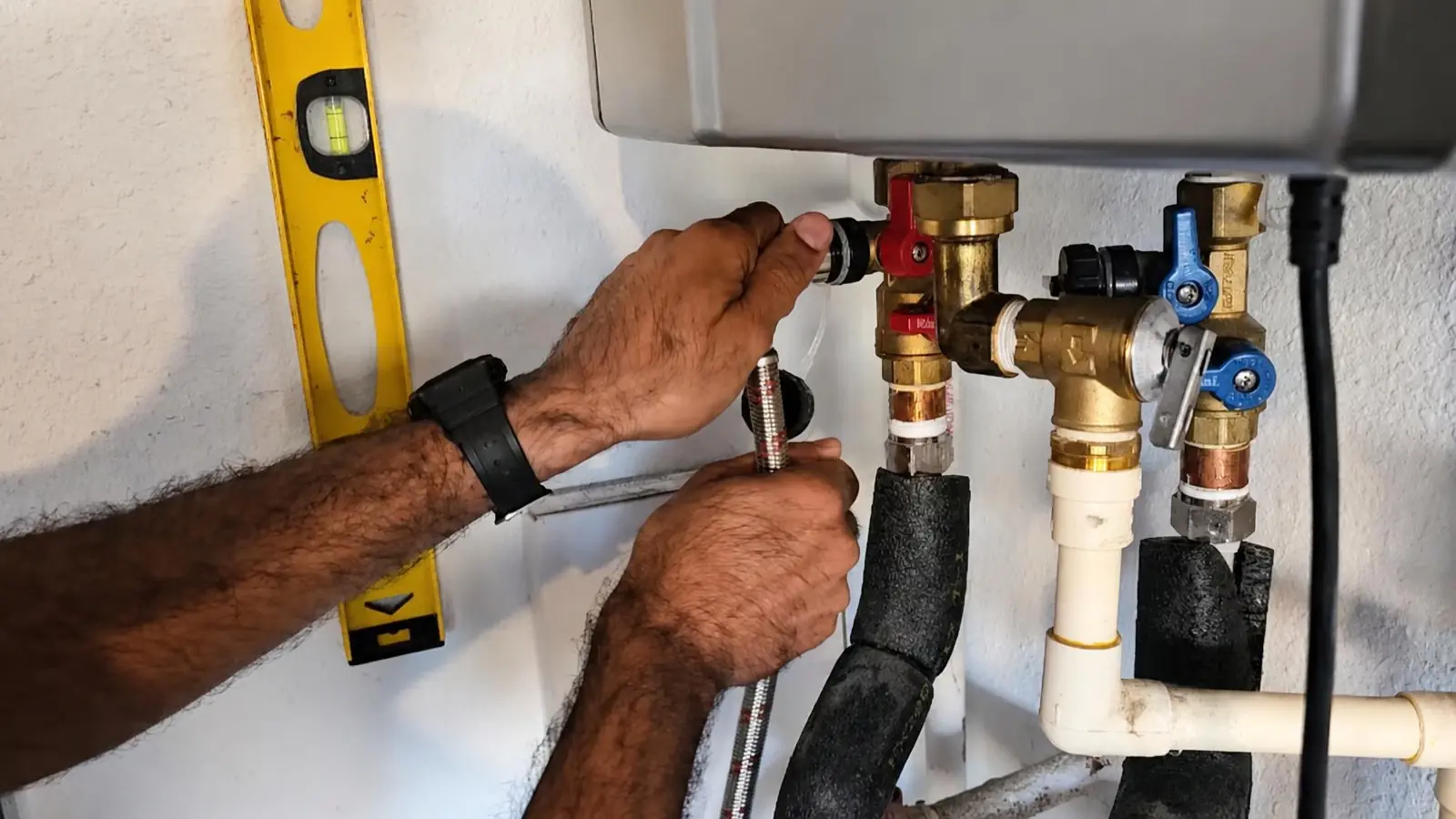
How a tankless heater works
When a hot tap opens, a flow sensor starts the burner or heating element and water passes through a heat exchanger. The unit raises the temperature as the water moves, so there is no tank to run out.
The catch is that the heater has a limit on how much water it can warm at once. In winter, incoming ground water is much colder, so the same unit delivers a lower flow at a given temperature than it would in summer.
Tank versus tankless
Tankless
- Hot water for as long as you need it
- Compact and wall mounted
- No standby heat loss
- Higher purchase and install cost
- Needs flushing, especially with hard water
Tank
- Lower upfront cost
- Simple to repair and replace
- Large amount of hot water at once, then recovery
- Takes more floor space
- Standby heat loss while it holds water
Weighing a tankless upgrade?
Call and we will walk through what your home needs.
What needs to be right before install
Installation requirements
- Gas line size that supports the unit's maximum input
- Proper venting, usually a vertical or sidewall run in the manufacturer's approved material
- A condensate drain for condensing units
- A dedicated electrical connection for the controls
- Space for service access and clearance
- A way to flush the heat exchanger, with service valves
Gas line and vent are the usual surprises. We check them before quoting.
Condensing tankless units are more efficient and typically vent through plastic piping. They also produce acidic condensate that needs a drain and, in some cases, a neutralizer. The manufacturer's installation manual governs the details, and we follow it.
Hard water and flushing
Mineral scale builds up on the heat exchanger, restricting flow and reducing efficiency. It is the main reason tankless units lose performance. Hardness varies from one water system to the next, so test your tap or ask City of Cottage Grove Public Works for the water quality report.
A yearly flush with a descaling solution is a common recommendation. If your water is hard, a softener or a scale-reduction device protects the heater and the rest of your plumbing. See water softener service for options.
What to do if the unit shows an error
- Check the display code in the manual
- Make sure the vent outlet outside is not blocked by snow or debris
- Confirm the gas valve and the power are on
- Shut off the unit and call if you smell gas, which means leaving the home first
- Write down the code and when it appeared
A repeating code usually points to venting, gas supply or scale.
Repairs for tankless units
| Symptom | Likely cause | Fix |
|---|---|---|
| Cold water sandwich | Short run with a low flow demand | Adjust settings or add a small recirculation loop |
| Error code or no ignition | Vent blockage, gas supply or sensor | Diagnose and clear |
| Reduced flow | Scale or a clogged inlet filter | Flush and clean the filter |
| Water not hot enough | Flow too high for the unit or scale | Check sizing, flush and test |
| Leak at the unit | Fitting or heat exchanger failure | Repair or replace |
Is it a fit for your household?
A tankless heater suits a household that uses hot water in steady runs and wants to free floor space or avoid a tank. A busy family running two showers and a dishwasher at once needs a heater sized for that load, and in Minnesota winters the unit has to be sized for the cold inlet water, not the summer number.
If you are only replacing a failed tank, a tank replacement is quicker. If you want to compare costs and long-term savings, we can walk through it on a call.
Sizing for winter in Minnesota
Tankless units are rated by how much water they can heat by a certain temperature rise. In a Cottage Grove winter, when incoming water is very cold, the required rise is larger, so the same unit delivers fewer gallons per minute than in summer.
To size one, add up the fixtures likely to run at the same time, such as a shower and a dishwasher, then check the unit's output at a winter inlet temperature. Undersizing is the most common regret with a tankless purchase, and we would rather talk you into a larger unit or a tank than sell one that cannot keep up.
Code, permits and standards
Tankless installations are governed by the Minnesota Plumbing Code and, for venting and gas sizing, the manufacturer's installation standards, which are strict about vent material, length and clearances. We follow the manual exactly, since an incorrect vent is a safety issue.
Tankless Water Heater questions in Cottage Grove
Many manufacturers recommend about once a year, and more often with hard water. Check your unit's manual and test your tap hardness.
Yes, when sized correctly. Colder incoming water lowers the maximum flow at a given temperature, so the unit needs enough capacity for winter conditions.
Often yes, but gas line size, venting and electrical needs have to be checked. A plumber assesses these before quoting.
The unit, service valves for flushing, venting, gas and electrical connections, a condensate line for condensing models and testing.
Common causes include venting problems, low gas supply, scale or a failed sensor. Check the code in the manual and call if it repeats.
Tankless service covers Cottage Grove and the nearby east metro, with Hastings on the south side. See the service area page for the list.